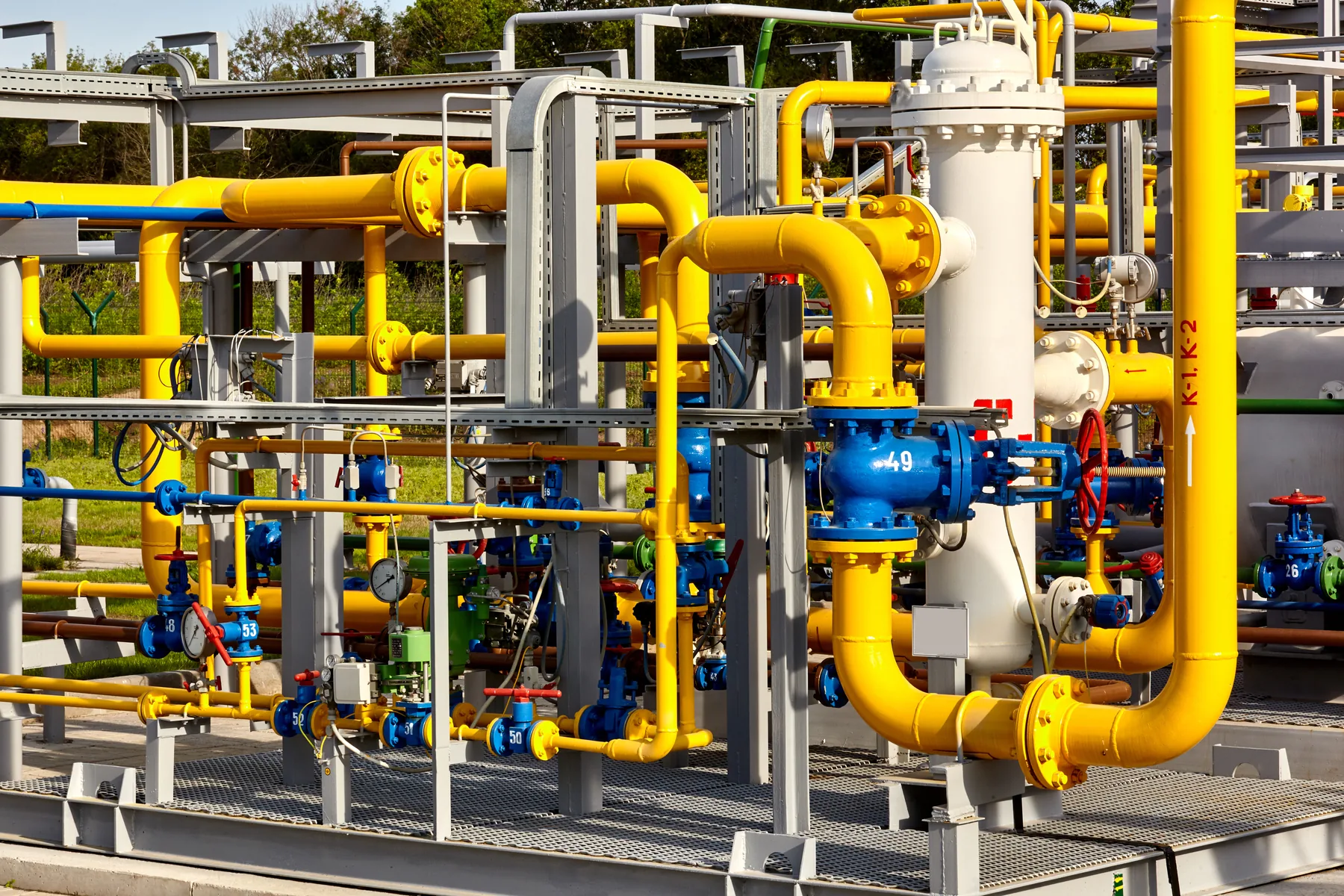
Keeping pipe scale, weld slag and corrosion products out of the equipment they would otherwise damage.
A pipeline delivers more than the process fluid. Mill scale, weld slag, grinding debris, rust and corrosion products all travel with it — heaviest immediately after construction or any upstream piping work, but never entirely absent in service.
A strainer is the piping component that removes that particulate before it reaches equipment which cannot tolerate it. This page covers protection of static inline equipment — control valves, flow meters, heat exchangers, steam traps, spray nozzles and pressure regulators. Where the equipment being protected is a pump or compressor, suction hydraulics govern the selection instead, and that is a separate engineering problem.
Particulate carried into a control valve erodes trim and can prevent the seat closing fully. The result is passing flow, loss of control authority and eventually a valve overhaul.
Flow meters, orifice plates and nozzles rely on a defined geometry. Debris that lodges in or wears that geometry shifts the measurement, often without any obvious alarm.
Heat exchanger tubes, steam traps and spray nozzles have small flow passages. Partial blockage reduces duty and raises pressure drop; full blockage takes the equipment out of service.
The strainer is positioned upstream of the equipment at risk, with the filtration rating set by the smallest flow passage or tightest clearance in that equipment — not by a default mesh. A finer screen than the equipment requires simply raises pressure drop and shortens the interval between cleanings.
Screen open area is then sized so the required flow passes within the allowable pressure drop, with enough dirt-holding capacity that the cleaning interval suits how the plant is actually operated. Body configuration and orientation follow the piping layout and the access available for removing the screen or basket.
Six governing inputs, one evaluation, four engineered outputs. On general pipeline protection the sensitivity of the protected equipment sets the filtration rating, and everything else follows from it.
Filtration rating is set by the equipment being protected, then checked against the allowable pressure drop — not chosen first and justified afterwards.
| Requirement | Possible Solution |
|---|---|
| Compact installation, moderate dirt load | Y Strainer · Tee Strainer · Wafer Strainer |
| Higher dirt-holding capacity required | Basket Strainer |
| Cleaning without interrupting the process | Duplex Strainer · Automatic Strainer |
| Commissioning and start-up only | Temporary Cone Strainer |
Selection depends on line size, dirt loading, allowable pressure drop, filtration requirement and the maintenance philosophy for the installation. No single configuration is correct for all process lines.
Send these and we can size a strainer for the line. Partial data is fine — we will tell you what is missing.
Bodies, screens and internals are selected for compatibility with the process fluid and service conditions, in cast or fabricated construction depending on line size and project requirements. Carbon steel, low-temperature carbon steel, alloy steel, stainless steel, duplex, super duplex and nickel alloys are available. Grades should be confirmed against the actual fluid, pressure and temperature for each project.
Install with clearance to withdraw the screen or basket without disturbing piping alignment. Establish the cleaning interval from the observed pressure-drop rise across the strainer rather than a fixed calendar period. Where the line cannot be taken out of service, specify a duplex or automatic arrangement at design stage rather than retrofitting later.
Because filtration rating and pressure drop work against each other. A finer screen raises pressure drop for the same flow and fills faster with the same dirt load, shortening the cleaning interval. The rating should be set by the smallest clearance in the equipment being protected.
Upstream of the equipment being protected, and close enough that the protected item is not exposed to debris generated between the two. Allow access clearance for screen removal at the design stage.
Debris loading is highest at commissioning and after upstream piping work, but corrosion products and scale continue to be generated in service. A temporary cone strainer covers commissioning only; a permanent strainer covers the operating life.
From the differential pressure across the strainer. A rising pressure drop at constant flow indicates the screen is loading up. Pressure tappings or a differential pressure gauge make this measurable rather than assumed.
Broadly, strainers remove larger particulate that would damage or block equipment, using perforated or mesh screens, and are cleaned and reused. Filters target finer contamination, often with replaceable elements. The boundary is application-specific rather than a fixed particle size.
Send line size, flow rate, fluid and service, pressure and temperature, the equipment being protected and its smallest clearance — we will come back with a configuration and filtration rating.
Submit RequirementNot sure what filtration rating your equipment actually needs? Describe the equipment and duty and we will work through it with you.
Talk to an Engineer