Featured Solutions Y Strainer Simplex Basket Strainer Duplex Strainer Tee Strainer Automatic Strainer Conical Strainer Suction Diffuser Wafer Strainer Accessories Company Resources Contact us
Large-Diameter Pipeline Straining
Solution 06

Large-Diameter
Pipeline Strainers

High-flow, large-bore lines where fabricated construction, screen area, weight and access govern the design.

Sizes
To 78″+ (1980 mm+)
Construction
Fabricated
Governed By
Flow & access
Watch
Weight & support
02 — Overview

Why large bore is a different problem

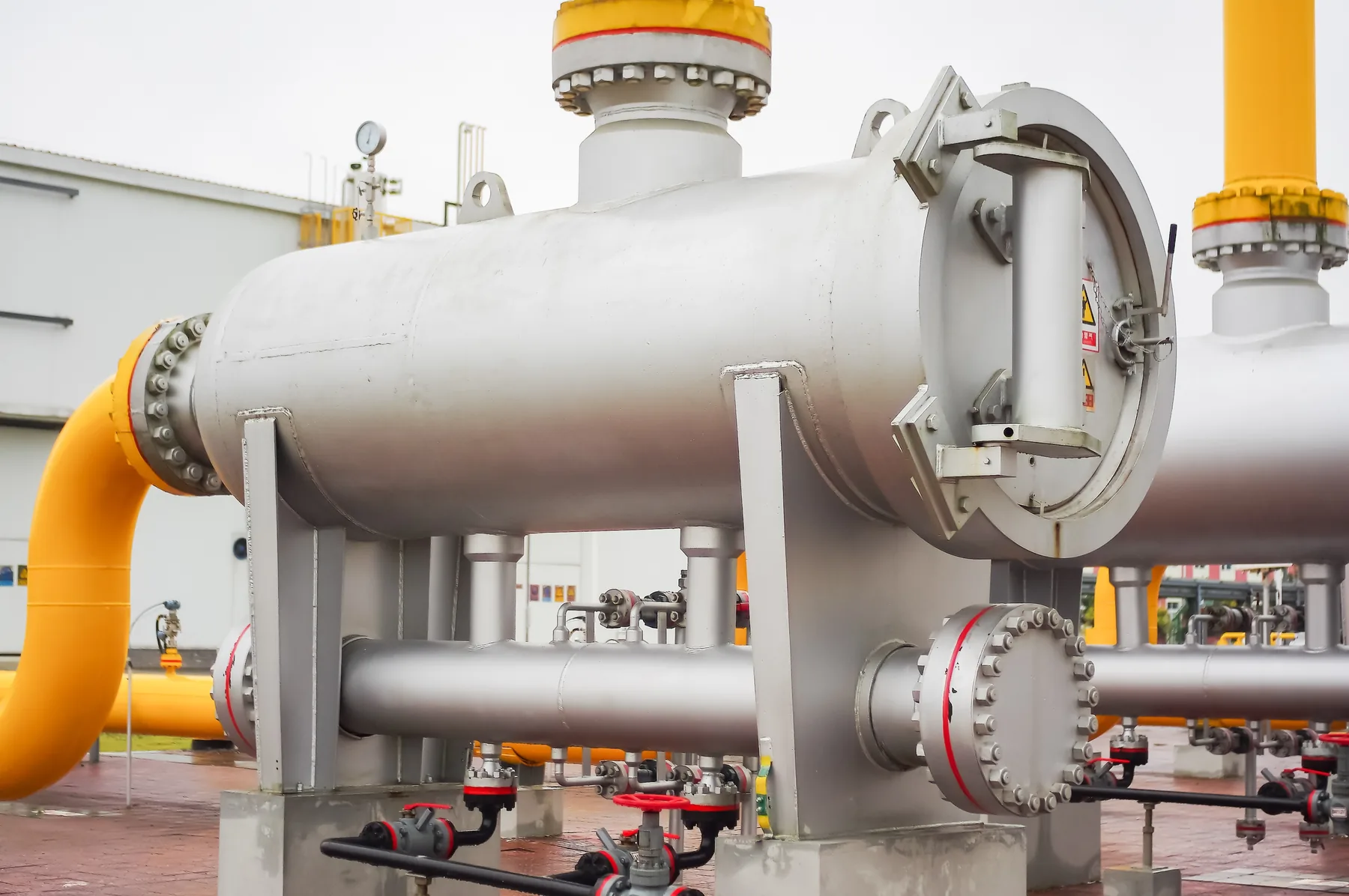
Above a certain diameter a strainer stops being a piping component that can be lifted by hand and becomes a fabricated vessel that has to be supported, accessed and maintained like one. Cast bodies are not available at these sizes, so construction is fabricated and the design is driven by flow area, weight and access rather than by a catalogue size.

Hydrotherms supplies fabricated basket and tee strainers to 78″+ (1980 mm+) and fabricated duplex strainers to 48″+ (1200 mm+). At these diameters the practical questions are how the basket is removed, how the unit is supported, and how the assembly is lifted and handled — and those answers have to be settled during design.

03 — The Engineering Challenge

What large bore actually changes

01 / Handling

Basket Weight

A large basket loaded with debris can exceed safe manual handling well before the strainer reaches its maximum size. Davit arms, hinged covers or lifting provision have to be designed in, not improvised.

02 / Support

Load & Nozzle Reactions

The filled weight of a large strainer imposes real loads on the piping. Support arrangement, and often a skid or support legs, has to be considered alongside the piping stress analysis.

03 / Access

Clearance for Removal

The space needed to withdraw a large basket is substantial and vertical. If it is not reserved in the plant layout, the strainer can be installed and still be effectively unmaintainable.

04 — Our Engineering Solution

Fabricated, supported and accessible

Large-bore strainers are fabricated to suit the required diameter, pressure class and flow area, with screen surface area sized to hold the pressure drop within the allowable figure at full flow. Where the required open area exceeds what a single basket can present, multiple basket arrangements or wedge-wire and pleated elements are used to increase surface area without increasing body size proportionally.

Access is engineered alongside the hydraulics. Quick-opening closures, hinged covers and davit arms make the basket recoverable at sizes where manual handling is not realistic, and support legs or skid mounting carry the filled weight. Welding is carried out to ASME IX with NDE to code requirements, and offset or rotated nozzles can be provided where the piping layout demands it.

05 — How We Engineer the Solution

The selection sequence

Six governing inputs, one evaluation, four engineered outputs. At large bore the maintenance access and support arrangement carry as much weight as the hydraulic sizing.

PROCESS INPUTSEVALUATIONENGINEERED OUTPUTFlow rateLine sizeAllowable pressure dropRequired filtration ratingAvailable clearanceHandling & lifting limitsLARGE BOREDESIGNFabricated body sizingScreen / basket areaAccess & lifting arrangementSupport & mounting

Clearance for basket withdrawal is treated as a design input, because a strainer that cannot be opened in situ cannot be maintained.

06 — Strainer Selection

Which configuration fits?

RequirementPossible Solution
Large bore, high dirt-holding capacityFabricated Basket Strainer — to 78″+
Large bore, continuous dutyFabricated Duplex Strainer — to 48″+
Large bore, compact space envelopeFabricated Tee Strainer
Large bore, high or variable solids loadAutomatic Strainer — to 48″+

At large diameters the deciding factors are usually the available clearance for basket removal and the acceptable downtime for cleaning, rather than the strainer body itself.

07 — Design Parameters

What we need to size it

For large-bore duties we also need the space envelope and any site handling limits, because they constrain the design as much as the flow does.

Fluid / Service
Process medium
Line Size
Nominal bore
Flow Rate
Design / normal
Operating & Design Pressure
Barg / psig
Operating & Design Temperature
°C / °F
Allowable Pressure Drop
Across strainer
Required Filtration Rating
Mesh / perforation / micron
Material Requirement
Fluid compatibility
End Connection
FLG / BW / SW / SCR
Installation Orientation
Piping layout
Drain / Vent Requirement
Chamber drain-down
Maintenance Philosophy
Access & downtime
Available Clearance
For basket withdrawal
Handling Limits
Crane / manual
08 — Typical Applications

Where this is used

Cooling water intake and circulationSeawater and desalination systemsLarge pump station suction and dischargePower station circulating waterWater treatment and distributionBulk transfer pipelines

What this achieves

Fabricated construction suited to diameters beyond cast availability
Screen area sized to hold pressure drop at full flow
Basket access engineered for the size rather than assumed
Support and mounting considered with the piping loads
Welding to ASME IX with NDE to code requirements
10 — Materials & Installation

Selected for the application

Fabricated construction in carbon steel, low-temperature carbon steel, alloy steel, stainless steel, duplex and super duplex, and nickel alloys. For seawater and similar service, special external and internal coatings and zinc anodes are available. Material selection should be confirmed against the fluid, temperature and corrosion requirements of the project.

Clearance, support and lifting

Reserve the vertical clearance required to withdraw the basket, and confirm it against the installed elevation early in the layout. Specify support legs or skid mounting for the filled weight, and davit arms or hinged covers where basket handling exceeds what is reasonable manually. Confirm lifting points and total assembly weight before the unit arrives on site.

11 — FAQ

Common selection questions

Fabricated basket and tee strainers are available to 78″+ (1980 mm+), fabricated duplex strainers to 48″+ (1200 mm+), and automatic self-cleaning strainers from 4″ to 48″+ (1200 mm+). Consult Hydrotherms for sizes beyond these ranges.

Cast bodies are not practically available at large diameters. Fabricated construction also allows the body geometry, nozzle orientation and screen area to be configured to the specific duty and piping layout rather than to a standard casting pattern.

Through a quick-opening closure or hinged cover, usually with a davit arm to swing the cover and support the basket. The vertical clearance for withdrawal has to be reserved in the layout — it is frequently the constraint that determines where the strainer can be installed.

Usually. The filled weight of a large strainer imposes significant load, so support legs or skid mounting are commonly provided and the arrangement should be considered together with the piping stress analysis.

By screen surface area. Where a single basket cannot present enough open area, multiple basket arrangements, pleated baskets or wedge-wire screens increase the effective area without a proportional increase in body size.

13 — Technical Enquiry

Request engineering assistance