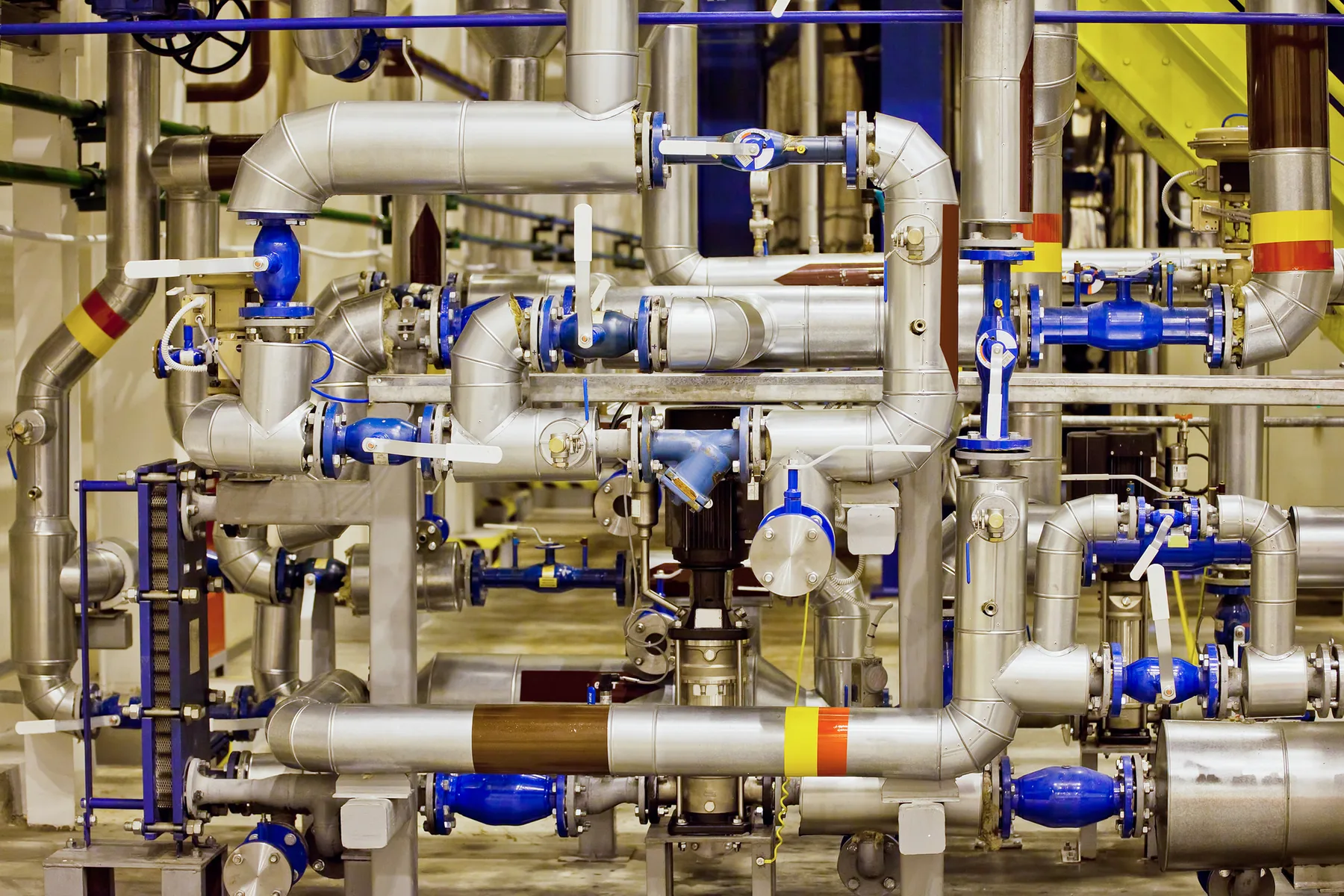
Where pressure class, design temperature and material qualification govern the body, cover, screen and bolting.
At severe conditions a strainer stops being a screen in a housing and becomes a pressure-containing component. Body and cover thickness follow from the design pressure and temperature; the flange rating, bolting, gasket and cover arrangement all have to be consistent with the class, and the material has to retain adequate properties at the design temperature.
Temperature also drives the choices that are easy to overlook. Material allowable stress falls as temperature rises, so a grade acceptable at ambient may not be at duty. Differential expansion between body, screen and bolting has to be accommodated, and gasket and sealing materials have to be rated for the temperature — often the first component to limit the assembly.
The body and cover are pressure-containing parts. Wall thickness, flange rating, bolting and cover design all follow from the design pressure and temperature, not from the line size alone.
Allowable stress falls as temperature rises. A material adequate at ambient may not be at design temperature, and the gasket or seal is frequently the limiting element in the assembly.
Repeated heating and cooling works on bolted joints and sealing elements. Cover arrangement, gasket type and bolting have to be selected for the cycling the service will actually see.
Selection begins from design pressure, design temperature and pressure class, with the body and cover configured accordingly — cast construction where the size and class suit it, fabricated construction where they do not. Hydrotherms Y strainers are available to API 10,000 lb for socket weld, butt weld and flanged ends, and fabricated strainers to Class 2500 lb+ (172 BarG+).
Material grades are selected against the temperature as well as the fluid, drawing on carbon steel and low-temperature carbon steel, chrome-moly grades, stainless steels, duplex and super duplex and nickel alloys. Welding is carried out to ASME IX and NDE to code requirements, with EN 10204 Type 3.1 certification supplied as standard and Type 3.2 or NACE MR0175 / ISO 15156 compliance available where the service requires it.
Six governing inputs, one evaluation, four engineered outputs. At severe conditions the pressure class and design temperature are fixed first — the screen is sized within what they allow.
Design temperature is applied to the material allowable, the gasket rating and the differential expansion of the assembly — not to the body alone.
| Requirement | Possible Solution |
|---|---|
| High pressure class, smaller bore | Y Strainer — to API 10,000 lb |
| High class with larger dirt-holding capacity | Fabricated Basket Strainer — Class 2500 lb+ |
| High class with continuous duty | Fabricated Duplex Strainer |
| Sour service at pressure | NACE MR0175 / ISO 15156 compliant construction |
Cast construction suits many pressure classes and sizes; fabricated construction is used where the size, class or geometry falls outside the cast range. Final configuration is confirmed against the project specification and applicable code.
For severe service the design conditions and the applicable code or certification requirement matter as much as the flow data.
Carbon steel and low-temperature carbon steel, carbon moly and chrome-moly grades, stainless steels including 304, 316 and 316L, duplex and super duplex stainless steel, and nickel alloys including Monel, Inconel and Hastelloy. Grade selection depends on design temperature and fluid as well as pressure, and should be confirmed against the project specification.
Cover bolting should be tightened to a defined procedure, and re-torqued after the first thermal cycle where the service and gasket type call for it. Allow for thermal expansion in the piping arrangement around the strainer, and confirm that the gasket and sealing elements are rated for the full design temperature range including start-up and shutdown transients.
Hydrotherms Y strainers are available to API 10,000 lb for socket weld, butt weld and flanged ends, and to ANSI Class 1500 lb for screwed ends. Fabricated strainers are available to Class 2500 lb+ (172 BarG+). Confirm your specific requirement with our engineering team.
Yes. Material allowable stress falls with temperature, so grade selection has to be made against the design temperature and not ambient. Gasket and sealing materials are often the limiting element and should be checked against the full temperature range.
The body and cover are pressure-containing components and are designed and manufactured accordingly. Whether a specific unit falls under a particular pressure equipment code depends on its size, pressure and the governing project specification — that is confirmed case by case.
EN 10204 Type 3.1 material certification is supplied as standard. Type 3.2 with independent third-party verification is available, as is NACE MR0175 / ISO 15156 compliance for sour service, combined with either 3.1 or 3.2.
Every strainer is hydrostatically tested prior to despatch. Additional testing — pneumatic, helium leak, radiographic, ultrasonic, dye penetrant, magnetic particle, cryogenic, impact, hardness, SSC and HIC among others — is available on request with the corresponding certificates.
Send design pressure, design temperature, pressure class, fluid and service, flow rate, line size and any code or certification requirement — we will confirm construction and material selection.
Submit RequirementWorking to a demanding specification? Send the datasheet or specification extract and we will review it against what we can supply.
Talk to an Engineer